The Ecology of Belonging

What if we reimagined wellbeing from the roots up?

A world where every child can flourish. Where communities, cultures, and ecosystems thrive together in harmonious interconnection.
Button
Button
The Model

Eco-Systemic Flourishing (ESF) Framework

An integrated framework connecting individual wellbeing with collective thriving. Explore the four domains and seven motivational levels that guide systemic transformation.


Cosmos
Nature
Others
Natural Environment
Circular & Regenerative Economics
Human Capacities & Potential
Cultural Values & Identity
GROWTH
Contribution
Fulfilment

Seven Motivations

Security

Relationship

Independence

Engagement

Fulfilment

Contribution

Growth

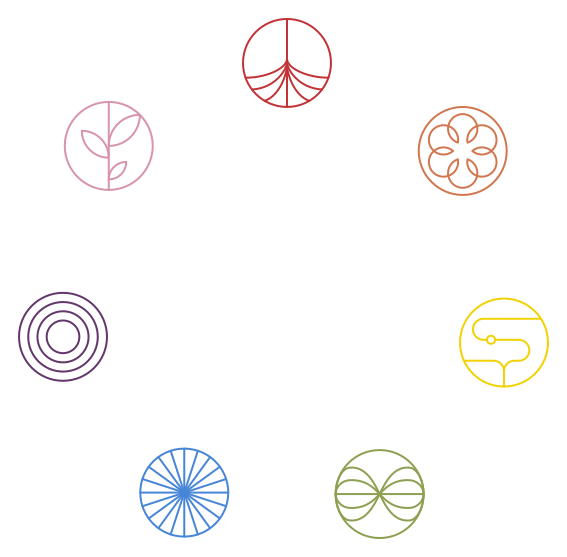
Natural Environment
Circular & Regenerative Economics
Cultural Values & Identity
Human Capacities & Potential
Self
Others
Nature
Cosmos
Find your path

Innovation Labs

Designing with and for Life

Every person has a unique role in creating a flourishing world. Find resources, tools, and community tailored to your context and aspirations.

The Wisdom Lab

The Wisdom Lab is an Innovation Lab dedicated to safeguarding the core principles that sustain life and ensuring they remain active, visible, and protected across all Flourish Project Labs.

Button

Conscious Parenting Lab

Supporting families in nurturing flourishing children through understanding developmental needs and creating thriving home environments - where child wellbeing is directly linked to parent wellbeing.
Button

Nurture Lab

Optimising early foundations - where safety, connection, and the beginnings of compassion take root. Our early relational experiences shape the lifelong patterning of values, motivations and worldviews, influencing how we learn to trust ourselves, others, and the wider world.
Button

Learning Lab

Supporting the the inner lives of teachers - and cultivating supportive learning environments that optimise curiosity, agency, creativity, and relational intelligence - qualities essential for navigating an interconnected world.
Button

Legacy Lab

Honouring the wisdom and legacy of eldership and supporting flourishing throughout the lifespan. Recognising the importance of intergenerational stories and that sustainable wellbeing arises when our choices align with ecological, cultural, economic, and human needs across time.
Button

City Lab

Understanding the soul of cities and the lived experience of place. Supporting towns and cities to grow as healthy ecosystems - where cultural identity, ecological wellbeing, inclusive economies, and human development are aligned rather than fragmented.
Button

Peace Lab

Focusing on the conditions that support social harmony, relational wellbeing, and the repair of disconnection. Showing that systemic balance and the understanding of others depends upon right relationship - with self, others and the natural world.
Button

Leadership Lab

Supporting the inner life of leaders. Building flourishing communities, cities and nations - through systemic approaches to governance and both local and national policy-making.
Button

Healing Lab

Global Healing Day is a worldwide call to collective healing - across people, communities and ecosystems. It is a decentralised movement inviting diverse actions, stories and gatherings dedicated to regenerating life on Earth.
Button
Button
Why Flourishing

Transforming wellbeing from individual to systemic

Traditional approaches to wellbeing focus on individual symptoms rather than systemic causes. Our research reveals that true flourishing emerges when we address the interconnected web of human capacity, cultural values, environmental health, and economic systems.

The Flourish Project was born from recognizing that our current global challenges — mental health crises, educational inequality, environmental degradation, and economic instability—are symptoms of the same underlying disconnection from what enables life to thrive.

Button
Button
Team

Weaving Wisdom Across Disciplines

The Flourish Project brings together researchers, educators, and systems thinkers who share a commitment to regenerative futures. Our team spans early childhood development, educational philosophy, urban ecosystems, and intergenerational care—each perspective essential to understanding how flourishing emerges across the human lifespan and within living communities.

We work as collaborative stewards rather than isolated experts, recognizing that the most generative insights arise at the intersections of our diverse practices and knowledge systems.
Wendy Ellyatt
Founder

Wendy Ellyatt is the founder of the Flourish Project and a futurist working across education, wellbeing, and systems change. Her work integrates human development, ecological thinking, and regenerative design to support cultures of lifelong learning and flourishing. She leads the development of the Flourish Framework and its associated Innovation Labs.
Simon Lightman
Learning Lab Development

Simon Lightman is an educational leader, researcher, and systems thinker focused on sustainability, educational futures, and ethical development. His work explores how schools cultivate ecological, moral, and epistemic capacities in young people. He leads programme development for the Flourish Learning Lab
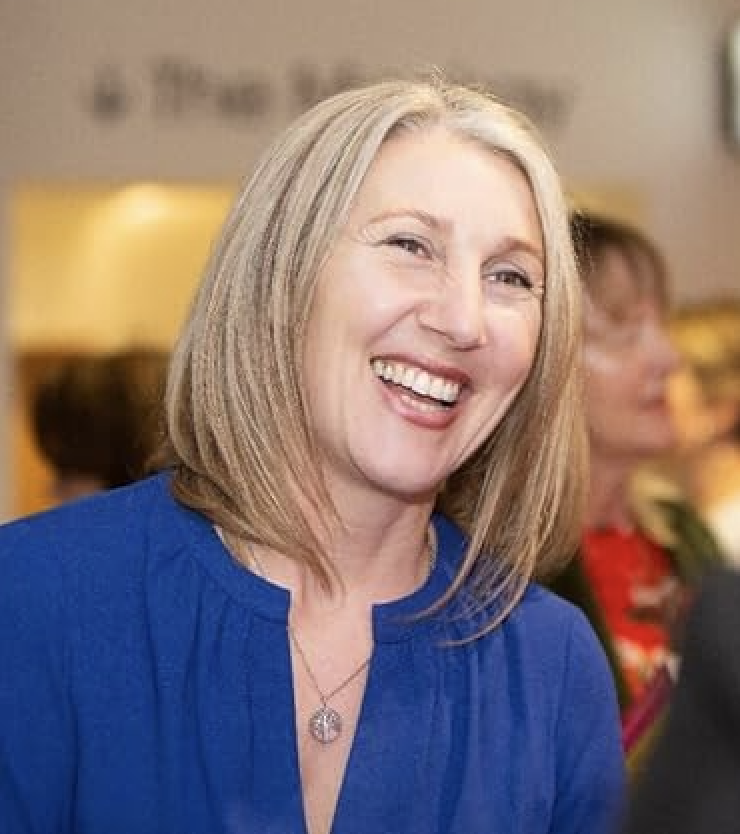
Fabienne Vailes
Associate Researcher for the Learning Lab

Fabienne Vailes is a researcher, author, and former language teacher currently undertaking doctoral research at the University of Bristol on flourishing and psychological safety in secondary schools. She is a Research Affiliate of the Flourish Project and contributes as an expert researcher to the Learning Lab

Dr. Harriet Broadfoot
Lead Researcher for the NURTURE LAB

Dr Harriet Broadfoot is an early childhood education researcher and teacher at Durham University, specialising in compassion, wellbeing, sustainability, and early environments. She is a Research Affiliate of the Flourish Project and leads research for the Conscious Parenting and Nurture Labs, with a particular focus on early human development

Dr. Marina Demchenko
City Lab Development

Dr Marina Demchenko is a social ecosystems evolution researcher, futurist, and Integral Development practitioner. A TED speaker and co-founder of Living Cities Earth and LCARE, she leads the partnered development of the Flourish City Lab, focusing on regenerative urban futures and systemic transformation
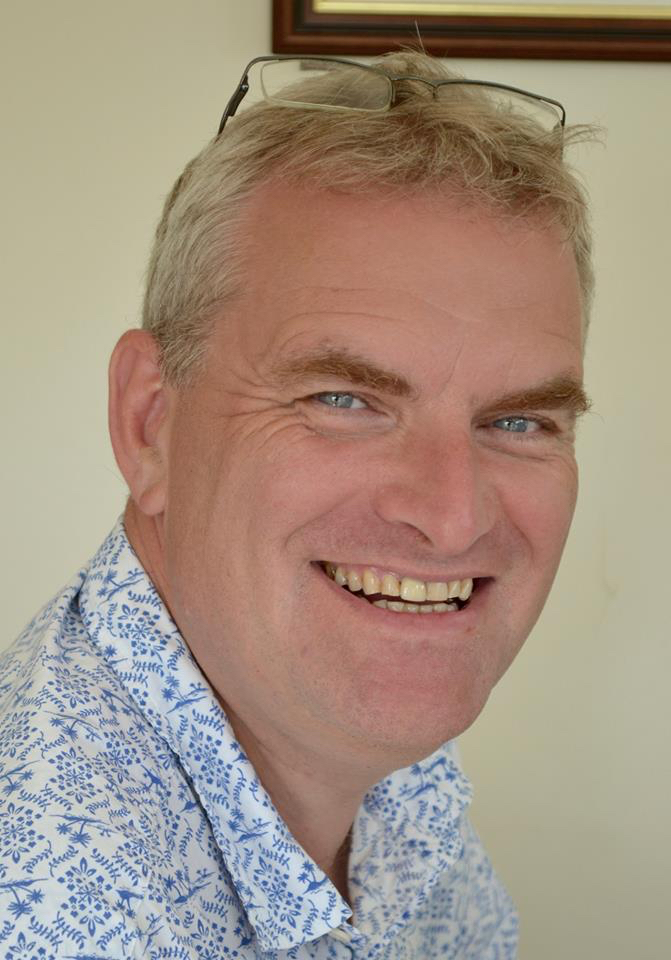
Simon Daisley
Legacy Lab Development

Simon Daisley is a strategist, trainer, and business coach with extensive experience in local government and care systems. An early supporter of the Flourish Project, he now leads programme development for the Legacy Lab, exploring how the Flourish Framework can enhance wellbeing in care and elder-care settings.
Annie Harvey
Associate Researcher for The Legacy Lab

Annie Harvey is a keynote speaker, educator, and author specialising in neuroscience, brain health, and emotional wellbeing. She is the author of The Still Effect and creator of intergenerational wellbeing programmes, including The Giggle Game. She is a Research Affiliate of the Flourish Project and co-leads research for the Legacy Lab.

Lana Jelenjev
Narrative Weaver

Lana Jelenjev is a healing-centered writer and facilitator working at the intersection of nervous system awareness, ancestral wisdom, and collective care. As a Narratives Weaver, she supports individuals and communities in making sense of complexity through story, reflection, and embodied practices.

James Bolden
Digital Liasson

James Bolden is founder of Iris Cocreative, a design studio serving consciousness-focused organizations. He is a design and technology advisor to the Flourish Project, focusing on digital tools for community facilitation and collaboration.
Dr. Marina Demchenko
City Lab Development

Dr Marina Demchenko is a social ecosystems evolution researcher, futurist, and Integral Development practitioner. A TED speaker and co-founder of Living Cities Earth and LCARE, she leads the partnered development of the Flourish City Lab, focusing on regenerative urban futures and systemic transformation

Simon Daisley
Legacy Lab Development

Simon Daisley is a strategist, trainer, and business coach with extensive experience in local government and care systems. An early supporter of the Flourish Project, he now leads programme development for the Legacy Lab, exploring how the Flourish Framework can enhance wellbeing in care and elder-care settings.

Annie Harvey
Associate Researcher for The Legacy Lab

Annie Harvey is a keynote speaker, educator, and author specialising in neuroscience, brain health, and emotional wellbeing. She is the author of The Still Effect and creator of intergenerational wellbeing programmes, including The Giggle Game. She is a Research Affiliate of the Flourish Project and co-leads research for the Legacy Lab.

Lana Jelenjev
Narrative Weaver

Lana Jelenjev is a healing-centered writer and facilitator working at the intersection of nervous system awareness, ancestral wisdom, and collective care. As a Narratives Weaver, she supports individuals and communities in making sense of complexity through story, reflection, and embodied practices.

James Bolden
Digital Liasson

James Bolden is founder of Iris Cocreative, a design studio serving consciousness-focused organizations. He is a design and technology advisor to the Flourish Project, focusing on digital tools for community facilitation and collaboration.
Resources

Open Resources for Change

PDF
Introducing the ESF Framework - Flourish Project, Sept 2025 .pdf

The document introduces the Eco-Systemic Flourishing (ESF) Framework, a holistic model for human and planetary wellbeing that addresses interconnected crises like climate change, social fragmentation, and mental health decline. The ESF Framework redefines flourishing as a dynamic, relational, and developmental process, integrating systems theory, Indigenous knowledge, developmental psychology, and ecological ethics. It features a four-domain matrix (Natural Environment, Circular & Regenerative Economics, Cultural Values & Identity, Human Capacities & Potential) and a seven-level model of human motivation. The framework emphasizes interdependence, moral development, and spiritual ecology, critiquing reductionist and anthropocentric wellbeing models. It is designed for practical application in education, governance, policy, and communities, offering tools for assessment and systems literacy. The document highlights the importance of early childhood in shaping worldviews, the need for education that fosters relational and ecological awareness, and addresses challenges like empirical validation and cultural adaptation. The ESF Framework is presented as a living, adaptable tool for regenerative societal transformation, aiming to unite inner development with systemic change for long-term flourishing.

Download Resource
PDF
Short Introduction to ESF.pdf

The document introduces Eco-Systemic Flourishing (ESF), a framework emphasizing that human wellbeing is deeply connected to the health of the systems we live in. It identifies current global issues—like environmental degradation, anxiety, and social division—as signs of systemic failure. ESF outlines seven ongoing human needs: security, relationship, independence, engagement, fulfilment, contribution, and growth, which shape interactions with self, others, and the world. The importance of early development is highlighted, as early experiences influence wellbeing across generations. ESF describes four essential, interconnected domains for flourishing: human capacities and potential, cultural values and identity, the natural environment, and circular/regenerative economics. The framework promotes a holistic perspective, noting that misalignment in one domain can destabilize others, while coherence fosters resilience. ESF is not a prescriptive program but a lens for understanding and improving the systems that shape humanity, relationships, and the environment, advocating for the design of systems that support development, relationships, and the living world.

Download Resource
Powerpoint
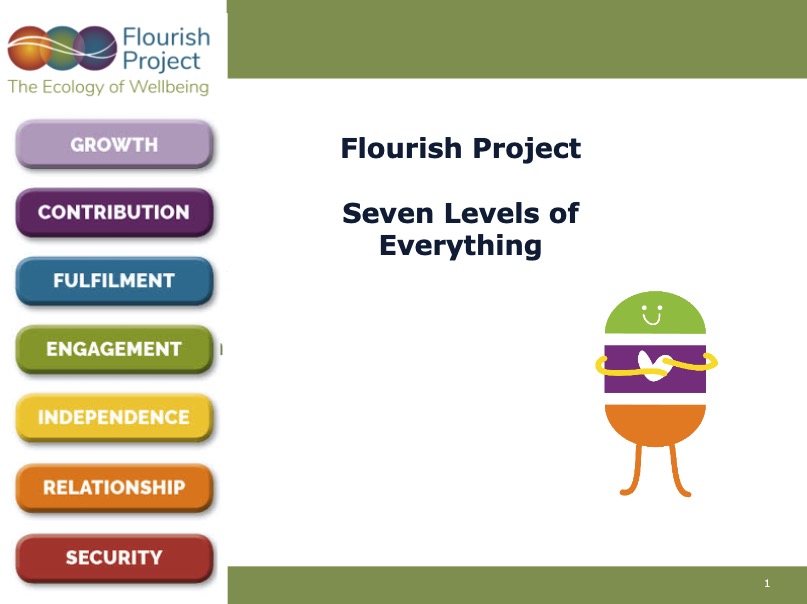
Seven Levels of Everything
The document outlines the Flourish Project's 'Seven Levels of Everything' model, a holistic framework for wellbeing applicable to individuals, communities, schools, and care settings. The seven levels—Growth, Contribution, Fulfilment, Engagement, Independence, Relationship, and Security—are each explored through reflective questions and linked to practical needs and resources for different groups. The model emphasizes human rights, personal and community development, emotional and physical health, and environmental sustainability. It connects to international wellbeing measures, educational competencies, and care frameworks, highlighting values such as empathy, resilience, creativity, inclusiveness, and safety. The document also provides examples of community resources, wellbeing apps, and care approaches (including Montessori and dementia care) that align with the seven levels, aiming to support holistic flourishing across all life stages and societal levels.
Download Resource
Word Document
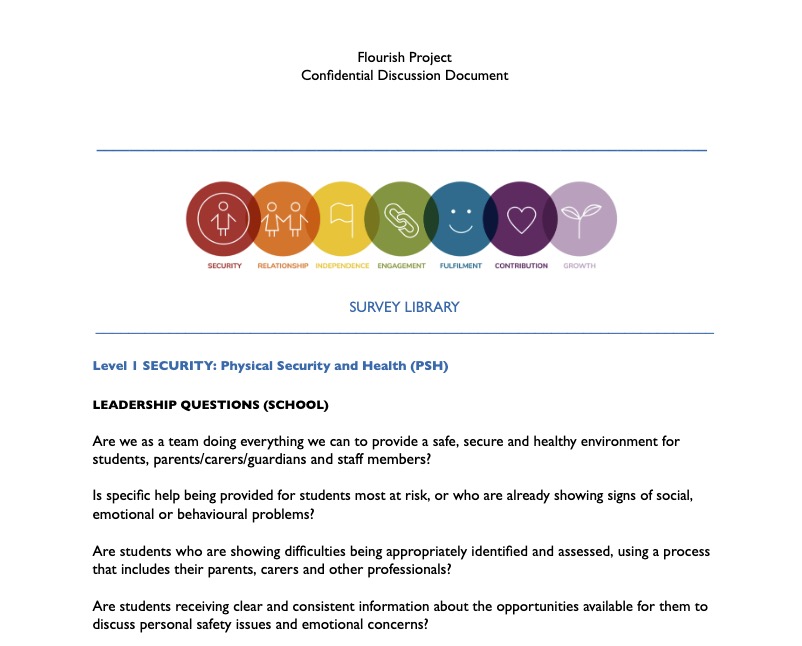
Digital Wellbeing Platform - Survey Library
The document is a survey library for schools aimed at assessing and promoting wellbeing among students, staff, parents/carers/guardians, and leadership. It is organized around seven key themes: Security, Relationship, Independence, Engagement, Fulfilment, Contribution, and Growth. Each theme includes targeted questions for different stakeholders to evaluate experiences and perceptions related to safety, mental health, relationships, self-worth, engagement, fulfilment, participation, and sense of purpose. The purpose is to help schools identify strengths and areas for improvement in wellbeing, fostering a supportive and inclusive environment for the entire school community.
Download Resource
Word Document
The ESF Wellbeing Evaluation Grades
The document describes the Eco-Systemic Flourishing (ESF) Grading System, which assesses wellbeing frameworks based on two main criteria: the depth of human motivation (across seven levels) and the breadth of ecosystemic integration (across four domains: Human Capacities & Potential, Cultural Values & Identity, Natural Environment, and Circular & Regenerative Economics). Frameworks are evaluated on five dimensions—Motivational Depth, Domain Breadth, Relational Integration, Ecological Consciousness, and Transformative Potential—each scored from 0 to 5, for a maximum of 25 points. Grades range from A (fully integrated, eco-systemic) to E (minimal integration). The system is applied to various frameworks, noting that Nova Scotia Community Wellbeing scores highly for participatory and ecological integration, while British Columbia Health Indicators is strong in basic needs but lacks growth and ecological focus. The document emphasizes the value of participatory, adaptive, and ecological approaches for higher ESF grades and suggests Nova Scotia could serve as a global model with further improvements.
Download Resource
Word Document
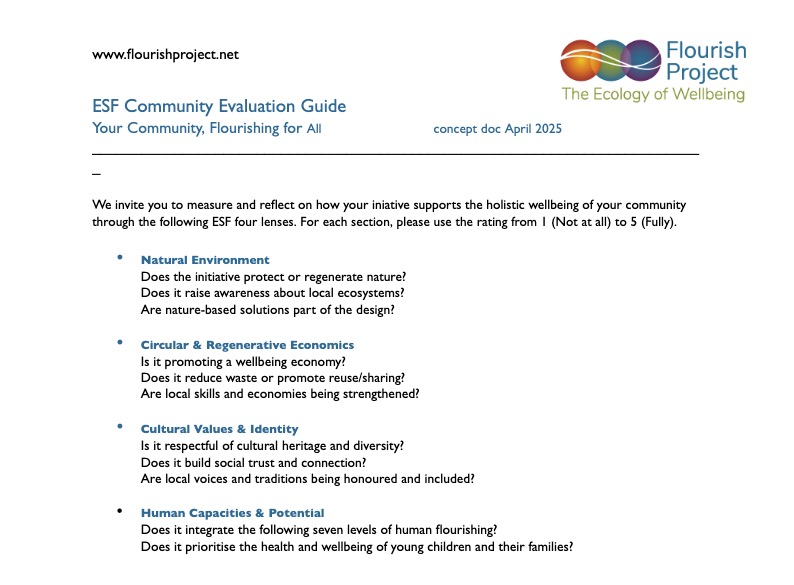
ESF Community Evaluation Guide
The ESF Community Evaluation Guide outlines a framework for assessing community initiatives through four key lenses: Natural Environment (focus on nature protection, ecosystem awareness, and nature-based solutions), Circular & Regenerative Economics (emphasizing wellbeing economies, waste reduction, and support for local skills and economies), Cultural Values & Identity (highlighting heritage, social trust, and inclusion of local voices), and Human Capacities & Potential (covering physical health, emotional safety, agency, meaningful activities, self-expression, participation, and intergenerational learning). The guide recommends rating each area from 1 to 5 to evaluate the initiative's overall impact on holistic community wellbeing.
Download Resource